
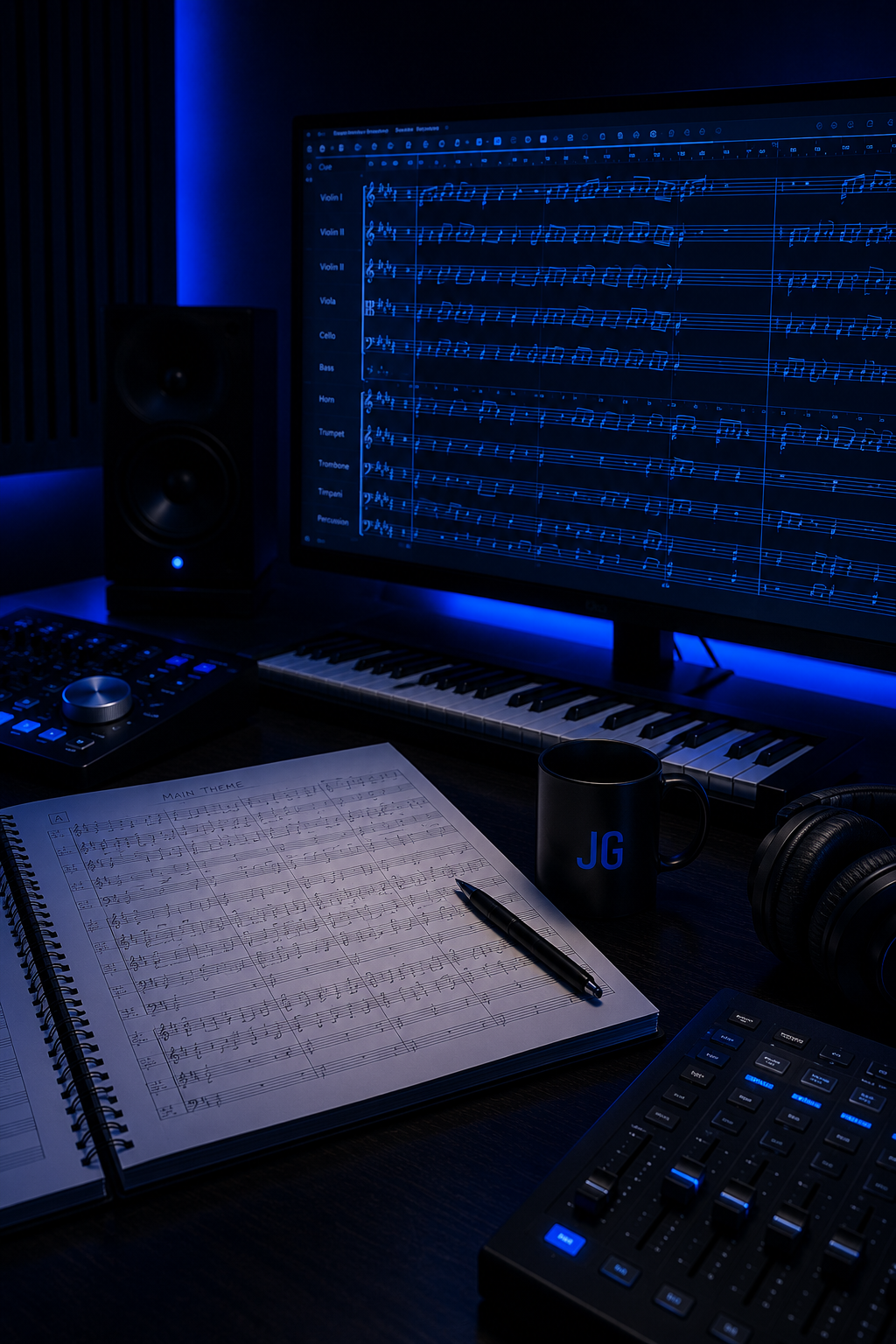
Composing and Arranging
Music can establish a mood, shape an emotional response, reinforce a message, or give a project an identity of its own. I can compose and arrange music for filmmakers, content creators, businesses, producers, and other clients who are looking for music that’s tailored to their project's specific needs. Whether you need an original score to be developed from the ground up or need an existing musical idea to be expanded into a complete arrangement, my goal is to create music that feels purposeful, distinctive, and connected to your vision.
Music That’s Created for Your Project
Every project is different. That's why I take the time to understand what the music needs to accomplish. A dramatic scene may need the music to support the emotion without overwhelming it. A commercial may need a memorable musical identity that communicates an idea in a matter of seconds. A corporate project may require something more polished and contemporary, while another project may benefit from a cinematic or orchestral approach.
Instead of starting with a predetermined sound, I take the time to understand the project's story, message, audience, and emotional direction. From there, I can develop the musical elements that will best support it (including melody, harmony, rhythm, instrumentation, texture, dynamics, and overall structure). The result is music that's created specifically for the project instead of music that's placed underneath it.
Original Composition
I compose original music for a variety of visual and creative applications. Some of them include the following:
Film and video.
Commercials and advertising.
Corporate and promotional media.
Documentaries.
Online and social media content.
Branded content.
Independent creative projects.
The music can range from intimate and understated to energetic, contemporary, cinematic, electronic, or orchestral. The goal isn't just to write a good piece of music. The goal is to write music that works for the project as a whole.
Arranging
Sometimes, the musical idea already exists. You may have a melody, chord progression, piano sketch, MIDI demo, lead sheet, or partially developed piece that needs to be expanded into a complete arrangement. I can help you transform that material by developing its structure, harmony, instrumentation, textures, transitions, dynamics, and overall musical direction.
Depending on your needs, these services can include:
Developing an existing musical idea.
Expanding a basic piano or MIDI sketch.
Creating introductions, transitions, and endings.
Developing accompaniment and supporting parts.
Reharmonization.
Instrumentation and voicing.
Structural development.
Adapting music for different ensembles or styles.
Preparing material for further production or orchestration.
The goal is to preserve what makes the original idea work while finding ways to make it more complete, expressive, and effective.
The Line Between Composing and Arranging
The line between composing and arranging isn't always clear, which is often a good thing. A composition may start with a simple theme, which can be developed as instrumentation and structure are explored. An arrangement may introduce new musical material that becomes an important part of the finished piece. Because I work in both areas, I can approach the music as a whole instead of treating both as isolated steps. This is useful when a project starts with an idea instead of as a finished musical blueprint.
From Initial Idea to Finished Music
While every project is different, here are some basic steps in my approach that help me to understand its scope:
Creative Direction – I start by discussing the project, its audience, the intended emotional direction, and the role the music needs to play. References can be helpful, but the goal isn't to copy existing music. I want to establish a common vocabulary for mood, energy, instrumentation, pacing, and overall direction.
Musical Development – I develop the core musical ideas and determine the appropriate structure, instrumentation, harmonic language, and production approach. For projects that involve writing music for picture, pacing, transitions, dramatic moments, and how the music interacts with the visuals must also be considered.
Review and Refinement – You will have an opportunity to hear the developing music and provide feedback. I will then make any revisions that can be helpful in refining the creative direction (all while keeping the project moving toward an agreed-upon result).
Production and Delivery – Once the final piece of music is approved, I complete the production and prepare the appropriate files for final delivery. Depending on the project, additional services (such as orchestration, music production, mixing, and mastering) can also be incorporated into the workflow.
Feel free to reach out to me if you have any questions.
A Musical Approach That's Built Around Story
One of the most important skills in writing music for media is knowing when the music should attract attention and when it shouldn't. Not every moment requires a sweeping melody or a dramatic musical statement. Sometimes a subtle texture, restrained harmony, rhythmic pulse, or carefully placed change in instrumentation will be more effective.
I approach every musical idea by thinking about how it will work with the project as a whole. It isn't just about what will sound good. It's also about what that moment needs. Making this distinction is what shapes my approach to composing and arranging music.
Modern Tools to Create Musical Direction
My workflow combines traditional musical knowledge with contemporary production technology. Using Cubase, virtual instruments, MIDI production, notation, audio processing, and modern production tools allows me to explore ideas quickly while having control over the finished music. But technology is only part of the process.
The decisions that matter the most remain musical. Choosing the right harmony, developing a melody, finding the appropriate instrumentation, shaping a transition, building tension, creating contrast, and knowing when simplicity is more effective than complexity is also important. The tools I use help me realize the idea and develop it into a cohesive product.
Pricing
Because every project is different, the final price will depend on certain factors (such as the music's length, complexity, instrumentation, intended use, and production requirements). It can also depend on turnaround time and the amount of development that's required to make the music work. For straightforward projects, I can often provide pricing based on the scope that's established during the initial discussion. Larger or more complex projects may require a custom quote.
My prices for composing and arranging music include the following:
Custom music up to 60 seconds: starting at $750.
Custom music from one to three minutes: starting at $1,250.
Longer scores: starting at $500 per finished minute.
Highly synchronized or production-intensive music: custom quote.
Pricing can include composition, virtual-instrument production, mixing, and delivery of the completed music. Alternate versions, stems, extensive revisions, live musicians, and expanded licensing may require an additional fee.
Licensing will be based on how and where the music will be used (including the intended audience, distribution platforms, territory, and duration of use).
Original compositions and professional arrangements will be developed in a way that aligns with your creative direction. Here is my pricing structure for these types of services:
Original composition: starting at $500 per piece.
Song arrangement: starting at $300 per song.
Piano, ensemble, or instrumental arrangement: custom quote.
Alternate arrangements or additional versions: custom quote.
The final pricing will depend on the project's length, instrumentation, musical complexity, and required deliverables.
You can also visit my main Pricing page for an overview of rates across all my services.
Hear My Work
The best way to understand what I do is to hear it. So, feel free to check out my portfolio to hear examples of my past work.
Developing Your Musical Idea
You don't need to come to me with every musical decision already made. You may have a finished creative brief, a reference track, a rough piano sketch, or an idea of how you want the audience to feel. By working together, we can determine what the music needs to become. And we can come up with an approach that fits your project.
Let’s create music that can help you tell your story.
Frequently Asked Questions
-
With a good understanding of its specific elements and how they can be applied, music can be composed in any type of style that’s appropriate to a specific project or audience. It will require an analysis of the genre itself (including specific chord progressions, instrumentation, and rhythmic patterns) so they can be blended together to form a cohesive musical structure.
-
Existing songs and themes can be arranged for specific instruments or ensembles, but permission will be required from the copyright holder for those works.
-
If there’s a “work for hire” agreement, then you will own the rights to the music once the services have been rendered and the payment has been completed. But if there’s a partnership agreement, the rights will most likely be split (which will require a split sheet or some other contract specifying any percentages).
-
Creating mockups or initial notation sketches is a common practice for making sure that everything in the composition works as it should. It’s also a valuable tool for getting feedback, which can be used for making revisions before the final product is delivered.
-
Composers and arrangers will often collaborate with performers, producers, and directors because of their importance during the creative process for films, TV shows, and theatrical productions. They can even play an important role in the recording industry. These collaborations will often involve translating a director’s vision into music, enhancing compositions with producers, and adjusting arrangements based on feedback.