
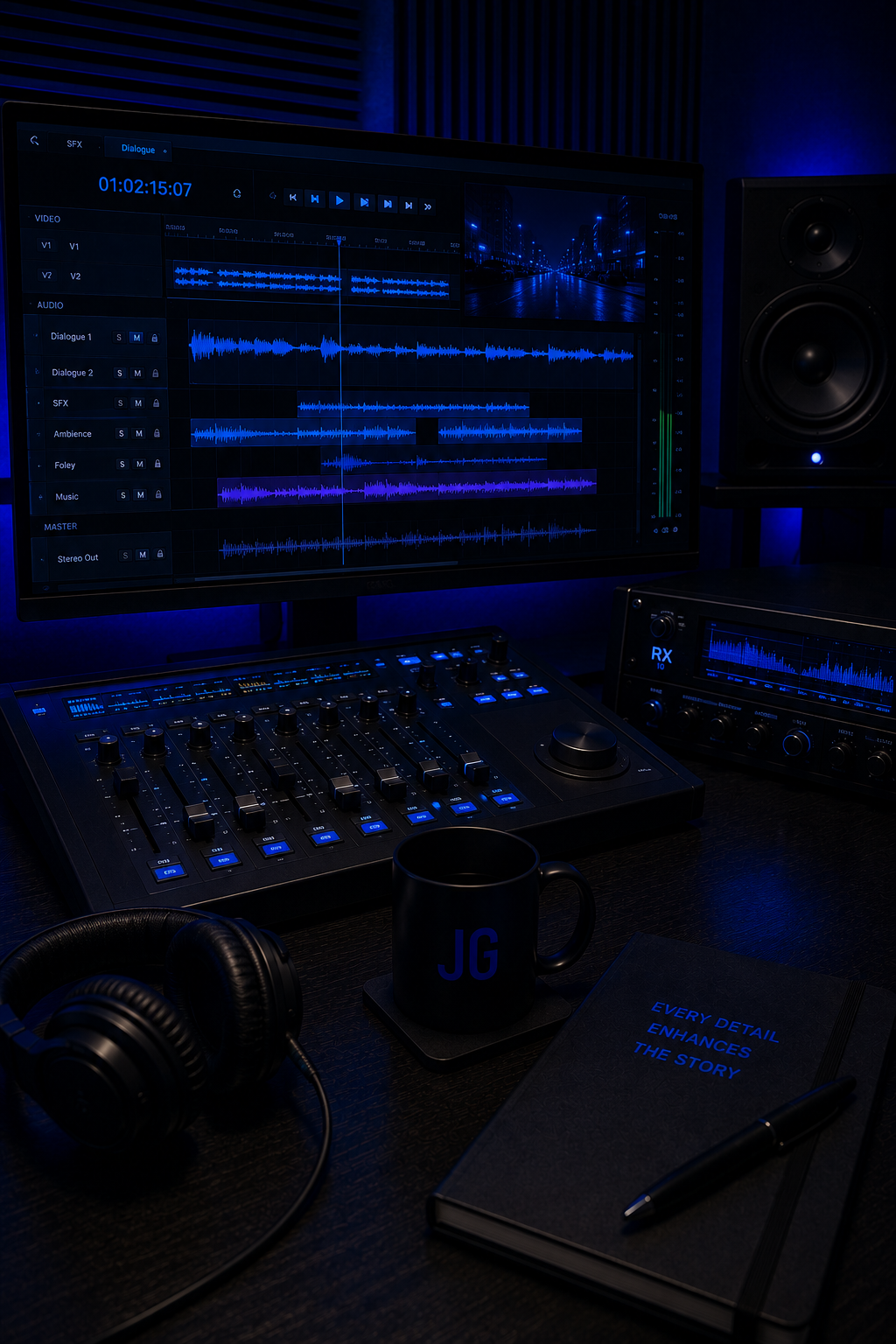
Audio Post-Production
Great visuals can capture an audience's attention, but sound plays an equally important role in determining how a finished production feels. Dialogue needs to be clear. Music needs to sit naturally within the project. Transitions need to feel intentional, and the different audio elements need to work together as part of a cohesive soundtrack.
I provide audio editing and post-production services for filmmakers, video producers, businesses, content creators, and other professionals who need clean, polished audio for their projects. Whether you have dialogue that needs editing, multiple audio elements that need to be assembled, or a complete video that needs its soundtrack prepared for final delivery, my goal is to make sure the audio supports the project instead of distracting from it.
Sound Is Part of the Story
Sound can influence how an audience interprets what it sees. Clear dialogue can help the audience stay focused on the message. Carefully placed music can reinforce emotion without overwhelming a scene. Ambiance can be helpful in creating a believable environment.
Even silence can become an important creative element when it's used effectively. That's why I approach audio post-production from both a technical and creative perspective. The goal isn't just to make everything louder or cleaner. It's to create a soundtrack that feels like it belongs with the picture.
Audio Editing
Raw audio often requires extensive preparation before it can become part of a finished production. Recordings can have unwanted pauses, inconsistent levels, distracting noises, awkward edits, timing issues, and other problems that can interrupt the listening experience.
Depending on the project, my audio editing services can include:
Dialogue editing.
Removing unwanted parts of a recording.
Cleaning up edits and transitions.
Timing adjustments.
Reducing distracting background noise when possible.
Managing breaths, pauses, and other unwanted sounds.
Level matching between different recordings.
Organizing and preparing audio tracks.
Editing music to fit with a video.
Creating clean fades and transitions.
Preparing material for mixing.
Synchronizing audio elements to video.
The goal is to make the edits feel transparent. The audience shouldn't even notice that the audio has been edited at all.
Dialogue Editing and Cleanup
Dialogue is often the most important part of a video soundtrack. If the audience can't understand what someone is saying, even excellent visuals can lose their impact. Dialogue recordings can also vary considerably (depending on the microphone, recording environment, distance from the speaker, room acoustics, and other factors).
I can help you prepare the dialogue by addressing any of the following issues:
Inconsistent levels.
Excessive pauses.
Distracting background noise.
Unwanted low-frequency rumble.
Harsh or problematic frequencies.
Differences between multiple speakers or recording environments.
Abrupt edits.
Timing problems.
Overall intelligibility and clarity.
Some recording problems can't be completely repaired in post-production, especially if dialogue has been recorded under difficult conditions. In these situations, I focus on improving the material as much as possible without introducing unnecessary artifacts. My ultimate goal is to create clear, natural-sounding dialogue.
Music Editing and Placement
Music will often need to be adapted for it to work properly in a finished video. A track may need to start at a particular visual moment, build toward an important transition, end cleanly with the picture, or leave room for dialogue. And lowering the volume isn't always enough.
Music editing can involve restructuring a track, creating new transitions, adjusting timing, extending or shortening sections, and shaping levels so the music supports the scene without competing with other important audio elements.
Because I also work as a composer, arranger, and music producer, I can approach these edits from a musical perspective. This allows me to think about phrasing, harmony, rhythm, structure, and musical development when I'm adapting music to picture (rather than treating the track as an audio file).
Audio Post-Production for Visual Media
My audio post-production services can be useful for a wide variety of projects. Some of them include the following:
Commercials and advertising.
Corporate videos.
Branded content.
Recruitment videos.
Documentaries.
Animation.
Independent film.
Interviews and testimonials.
Online video.
Social media content.
Promotional projects.
Other visual media.
Every project has different requirements. A 30-second commercial may need tight pacing and precise synchronization. A documentary may have extensive dialogue that's recorded in several different environments. A corporate video may need narration, music, interviews, and other audio elements to work together (all while maintaining clarity). The process changes with every project. But the goal is always the same: to create audio that supports the finished production.
Bringing the Elements Together
Most finished soundtracks have several different types of audio. Dialogue, narration, music, ambiance, and other elements may need to occupy the same sonic space. Every audio element has a different purpose.
Dialogue usually needs to remain intelligible. Music may need to provide emotional support (while also remaining under the narration). Ambiance can give a scene context and continuity, and transitions between scenes need to feel natural instead of abrupt.
Audio post-production is the process of bringing those pieces together so they feel like parts of the same whole instead of as unrelated recordings. This requires careful attention to timing, dynamics, frequency balance, spatial placement, transitions, and overall consistency.
Working With Music and Picture
My background in music gives me a unique perspective on audio post-production. Because I also compose, arrange, orchestrate, and produce music, I understand how it functions structurally and emotionally within visual media. This can be useful when determining where music should enter, how it should develop, when it needs to move behind dialogue, and where it should end.
If a project needs original music instead of an existing track, my composing, arranging, and music production services can also be incorporated into the project. This makes it possible for me to develop the music and audio post-production as connected parts of the same creative process.
The Limits of Audio Repair
Modern audio-processing technology can solve many problems, but it can't repair every recording. Severe clipping, extreme background noise, heavy distortion, poor microphone placement, and overlapping sounds can limit what's realistically possible.
It's important to be clear about those limitations before I start a project. When I review the material, I can identify potential problems and determine which improvements are achievable. If a recording can be improved, I'll do my best to make it sound as natural and polished as possible. If a problem can’t be corrected without compromising the audio, I'll explain the available options instead of promising a result that the source material can't support.
My Audio Post-Production Process
While every project is different, my audio post-production workflow usually involves the following stages:
Reviewing the Project – I start by reviewing the video, audio files, project requirements, as well as any notes or reference material you provide.
Organizing the Material – I prepare and organize the supplied audio so the dialogue, music, and other elements can be edited efficiently.
Editing and Cleanup – I address timing issues, unwanted sounds, dialogue edits, transitions, level inconsistencies, and other issues that require attention.
Building the Soundtrack – I assemble and balance the necessary audio elements to make sure they support the picture and each other.
Reviewing and Refining – You will have an opportunity to review the work and provide feedback before the final version is completed.
Final Mixing and Delivery – Once the edits have been approved, the project can proceed to final mixing and be prepared according to the required delivery specifications.
If your project also requires original music, music production, or additional mixing and mastering, those services can be incorporated into the same workflow.
Audio Post-Production and Technology
Modern audio post-production gives us access to powerful tools that can be used for editing, restoration, processing, synchronization, and mixing. My workflow allows me to work with dialogue, music, video, automation, EQ, dynamics processing, noise reduction, and other audio tools within a digital production environment. But processing will be more effective when it's used selectively.
Noise reduction can improve a recording, but excessive processing can make dialogue sound unnatural. Compression can be helpful in controlling dynamics, but too much of it can suck the life out of a performance. EQ can improve clarity, but it should solve a problem instead of being applied because the tool is available. Technology gives us the ability to manipulate sound, but good judgment tells us when to leave it alone.
Mixing for Picture
Once all the audio elements have been edited and prepared, they need to work together. During this stage, I focus on the following areas:
Dialogue clarity.
Overall level balance.
Music placement.
Frequency balance.
Dynamics.
Stereo placement.
Transitions.
Automation.
Overall consistency.
The final mix should guide the listener through dialogue, music, and other supplied audio elements without requiring the listener to think about what they're hearing.
Remote Audio Post-Production
My workflow is designed to be done remotely. Clients can provide video files, audio stems, dialogue recordings, music, project notes, and other required materials digitally. Before starting the project, we can establish the preferred file formats, technical specifications, and final delivery requirements.
This allows me to work with filmmakers, production companies, agencies, businesses, and content creators (regardless of location). For larger projects or productions with more specialized technical requirements, we can determine the appropriate workflow before starting the process.
Pricing
Audio post-production can vary in scope, so pricing will depend on a variety of factors. Some of them include the following:
The length of the project.
The number of dialogue tracks.
The condition of the source audio.
The amount of editing required.
Noise-reduction or cleanup requirements.
The number of audio elements involved.
Music editing requirements.
Synchronization requirements.
Mixing requirements.
Required deliverables.
The number of revisions.
Turnaround time.
Straightforward projects can often be priced after I review the material. Larger projects, extensive dialogue cleanup, or more involved post-production work may require a custom quote.
My pricing structure for each of these services includes the following:
Audio editing and restoration: fixed quotes starting at $200.
Podcast editing: starting at $175 per episode.
Short-form video under five minutes: starting at $300.
Dialogue cleanup and noise reduction: custom quote.
Audio synchronization and timing adjustment: custom quote.
Long-form film, video, or podcast projects: custom quote.
Pricing will depend on the length and condition of the source material, the number of tracks, the degree of cleanup required, the delivery specifications, as well as the project's deadline. If extensive restoration is necessary, I'll review the source material before confirming the scope and cost.
You can also visit my main Pricing page to look at my rates for all the services I provide.
Every Detail Matters
Good audio post-production isn't about drawing attention to what's happening behind the scenes. It's about removing distractions, creating clarity, supporting emotion, and helping every element of the soundtrack to work within the picture.
Sometimes, it’s about making a significant transformation. Other times, it’s about making dozens of small adjustments that the audience will never notice. Either way, the objective is the same: to make the finished project sound intentional, polished, and complete.
If you have a video, film, commercial, corporate project, or other production that needs professional audio editing and post-production, I'd be happy to discuss your needs.
Frequently Asked Questions
-
While I don’t do sound design per se, I have the skills, experience, and equipment to edit dialogue and sound effects (in addition to the music). Having clean dialogue is the most important element of any film, TV show, or podcast (at least in terms of audio). Not only is it the first thing that the audience will pay attention to, but it will also set the timing for the music and sound effects.
These audio elements will be mixed as separate and interdependent layers or stems, with each one being at different levels to make sure that one doesn’t overpower the other. The goal is to create a balanced experience for the listener.
-
While it isn’t always a “slam dunk,” noisy or poorly recorded audio can often be improved with the use of specialized software or tools. Some of the common techniques for cleaning up noisy audio include the following:
Applying plugins that are designed to reduce noise.
Using EQs to remove any unwanted frequencies.
Setting noise gates to silence any background noise.
Using de-clickers to remove clicks.
It’s important not to over-process, because too much noise reduction can make the audio sound like it’s “underwater” or metallic. The best strategy is to keep the noise from being there in the first place.
-
Audio post-production can involve editing, arranging, and enhancing audio for a variety of media projects (including films, TV shows, and games). The techniques can also be used in podcasts and radio shows, as well as commercials and voiceover projects.
-
Depending on the project, audio can be synchronized to timecode, but it can also be synchronized by using some other method. It can even be delivered as stems for easier placement into a larger session.
-
While some phases of the project may require an in-person meeting or session, most collaborative work with video editors, producers, and directors can be done remotely through the use of cloud technology and high-speed internet. Video conferencing tools (such as Zoom) will allow directors to review edits in real-time. Other platforms (such as Slack) can also be used to facilitate communication between various team members.