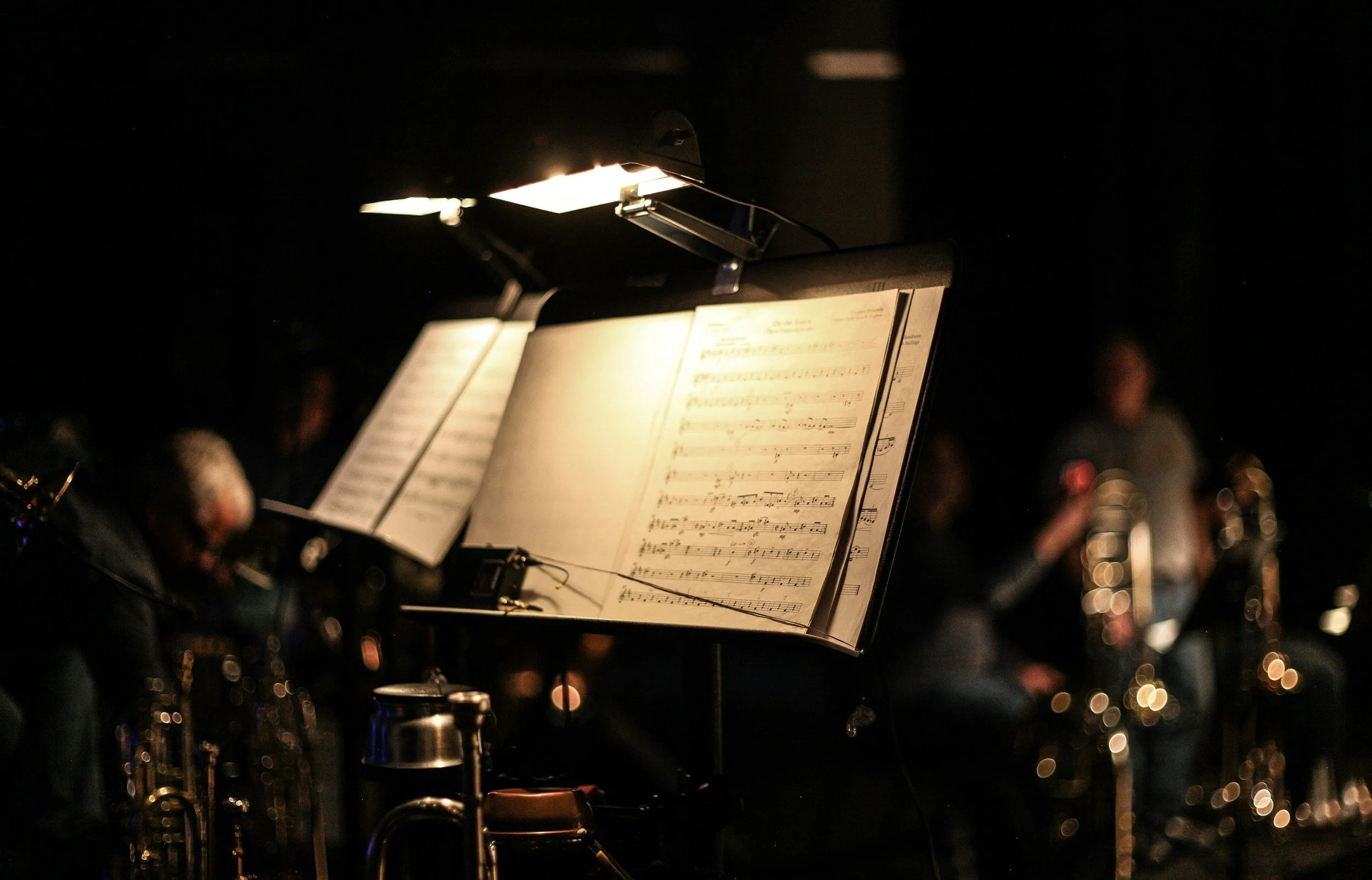
Orchestration
My orchestrations are designed to transform musical ideas into fully realized and expressive scores. Whether you’re starting with a piano sketch, a MIDI mockup, or a completed composition, I can shape each element to highlight the strengths of the ensemble and bring the music to life. With a strong understanding of instrumental color, range, and texture, I can put together an orchestration that’s technically sound and emotionally compelling. Every score I create will be tailored to the needs of live performance, recording, or media production.
My orchestration process can include the following:
Creating an orchestral arrangement from piano scores, lead sheets, or MIDI demos.
Instrumentation and voicing for chamber, symphonic, and hybrid ensembles.
Adaptation of existing works for new ensembles or formats.
Score preparation and professional notation.
Dynamic shaping, articulation, and expressive detail.
Optimizing scores for live performance and studio recording.
Collaborating with composers, arrangers, and directors to support a creative vision.
If you have any questions, concerns, or would like more information, feel free to reach out to me.
Frequently Asked Questions
-
The term “orchestration” refers to the process of assigning instruments to specific musical lines and phrases. It focuses heavily on timbre, texture, and balance within an ensemble. It’s different from composition (which creates the foundation for both melody and harmony) and arranging (which reinterprets or adds new material to a specific piece). The orchestration process focuses on how existing musical ideas will be played.
-
The orchestration will usually follow the original composition or mockup in terms of the melodic, harmonic, and structural content. But the live performance will often differ in detail, articulation, and sonic balance to compensate for the limitations of human musicians. A good mockup can be 90-95% accurate, but the final product (which is usually a live recording) is often considered to be “better” because it’s more expansive and more nuanced.
-
Existing orchestrations can be adapted or re-orchestrated for different ensembles, skill levels, or budgets. This process is often taken care of by an arranger or orchestrator, who modifies the instrumentation, voices, rhythms, and tempos to meet specific performance settings (all while maintaining the intent of the original piece).
Music can be adapted for different ensembles in the following ways:
Downsizing from large to small — Full orchestral pieces can be adapted for smaller chamber groups, concert bands, or chamber orchestras by reducing the number of parts, combining voices, or substituting instruments (such as replacing a horn solo with an alto saxophone).
Upsizing from small to large — A piano sketch, lead sheet, or small ensemble piece can be expanded to a full orchestral arrangement by assigning melodic and harmonic lines to appropriate orchestral colors.
Re-voicing — To maintain balance and playability, parts may need to be transposed or re-voiced to fit the range of other instruments.
To accommodate specific budgets, music can be adapted in the following ways:
Simplification — Dense scores that are more complex can be scaled down so the main focus is on the melody, harmony, and rhythm. That way, fewer musicians are needed to cover the basic elements of the piece.
Replacing specialist players — Unique or expensive instruments (such as the harp, bass clarinet, or English horn) can be omitted or replaced with more common and affordable options.
Flexible scoring — Arrangements can be created with more flexibility, so they can be played by a broad range of ensemble sizes.
Other common techniques for adaptation can include the following:
Changing Octaves — This is a simple yet effective way to make high or low parts more comfortable for different instruments.
Swapping Parts — Melodic lines can be moved between sections to compensate for missing players.
Layering and Doubling — Fewer instruments can be used if they play multiple roles. You can also double the lines for a richer sound in a larger group.
The process of adapting music often involves the use of specific tools (including the use of MIDI, XML files, and notation programs).
-
After the mockup has been created, the MIDI data can then be exported and uploaded into a music notation program. This is where the final score and parts can be created.
-
Making sure that an orchestration is playable by live musicians requires an understanding of the physical limitations, ranges, and techniques of each instrument instead of relying on MIDI samples. Some of the important strategies include the following:
Giving wind players the appropriate amount of breathing room.
Respecting the bowing constraints of string instruments.
Avoiding the excessive use of the high register for brass players.
Providing clear, idiomatic notation.
It’s also important to understand the practical playing ranges (called the “tessitura”), timbre, and technical limitations of every instrument in the orchestra.
-
Orchestrators will often collaborate with composers, directors, and music supervisors by serving as an important bridge between musical conception and final production. They can translate short scores or melodies into full arrangements while making sure the musical vision meets the director’s dramatic needs and fits within the project's technical, budgetary, and time constraints. They can also turn sketches into full, playable scores with defining harmonies and instrumentations to match the composer’s desired emotional effect.
-
Orchestrators can take composer sketches, MIDI files, or DAW sessions and turn them into complete scores for film, television, video games, and live performances. This can include arranging, transcribing, and creating sheet music for live players. This process can apply to both traditional instrumentation and hybrid scores (where the orchestra is used in combination with various electronic instruments and synthesizers).