
Music Production
A good piece of music starts with an idea, but transforming it into a finished production requires more than just good composition. Music production is where the creative and technical sides of the process come together. Arrangement, instrumentation, sound selection, performance, editing, dynamics, texture, effects, and many small decisions contribute to the way the music sounds and feels.
I provide music production services for composers, filmmakers, content creators, businesses, and other creative professionals who need help in taking musical material from its initial concept to a finished production. Whether you have a piece that needs development or are starting with an idea, I can help you determine what the music needs and build the production around it.
More Than Recording Music
Music production is sometimes thought of as the process of recording instruments and vocals, but modern production involves a lot more. A producer needs to think about the music as a whole. Does the arrangement build naturally? Are there too many elements that are fighting for attention? Does the instrumentation support the emotional direction? Should a section become larger or more intimate? Does the production have enough contrast? Is the sound appropriate for the project and audience?
These decisions can have as much impact on the finished result as the notes themselves. My approach is to treat production as an extension of the musical idea instead of as something that's added afterward. Every production decision should have a reason for being there.
From Concept to Finished Production
Music can approach the production stage in many different ways. You may already have a completed composition or arrangement. You might have a MIDI mockup that needs some extra development. You could have a piano sketch, demo, chord progression, melody, or partially completed track.
I can work with material at different stages of development, which include the following:
Original compositions.
Existing arrangements.
MIDI sequences and mockups.
Piano or keyboard sketches.
Lead sheets and chord progressions.
Melody ideas.
Reference tracks.
Partially completed productions.
Existing sessions that need additional development.
If your music still needs work, my composing and arranging services can also be incorporated into the project. My goal is to create a continuous process from the initial musical idea through the finished production.
Building the Right Sound
Every project will have its own sonic identity. A cinematic score may combine orchestral instruments with synthesizers and electronic textures. A commercial may need to establish its musical personality within the first few seconds. Documentary music may need to be understated while still providing emotional direction. An animated project could call for dramatic shifts in instrumentation, energy, and style.
The production process can give me the tools I need to shape those characteristics. Depending on the project, it can involve any of the following:
Virtual instruments.
Orchestral libraries.
Synthesizers and electronic textures.
Piano and keyboards.
Percussion.
Guitars and other contemporary instrumentation.
MIDI programming.
Layering and sound selection.
Automation and effects.
Editing and timing adjustments.
Dynamic and structural development.
Hybrid orchestral/electronic production.
The goal isn't to use as many sounds as possible. The goal is to find the right combination of sounds for the music.
Production for Visual Media
Producing music for visual media requires a different perspective than producing a standalone track. The music is only part of a much larger experience. A production may need to build toward an important visual moment, change direction with a scene, leave room for dialogue, reinforce a transition, or disappear into the background when something else needs the audience's attention.
Not only do I think about how the music sounds by itself, but I also think about how it functions alongside picture, dialogue, and the other elements of the production. This approach can be useful in the following applications:
Commercials and advertising.
Corporate and branded content.
Recruitment videos.
Documentary projects.
Animation.
Film and independent media.
Online and social media content.
Promotional videos.
The best production doesn't always draw the most attention. Sometimes, it just needs to make the project more effective.
Arrangement and Production
Arrangement and production frequently overlap. Changing the instrumentation can alter the character of an entire section. Adding or removing layers can change the music's emotional intensity. A rhythmic element can create momentum. A new countermelody may help a section develop. Removing an unnecessary part can create space and clarity.
Because I also work as a composer and arranger, I can make those decisions from a musical perspective instead of treating production as a technical process. If the music needs structural development during production, I can address it as part of the larger creative process.
Orchestral and Hybrid Production
My background in orchestration allows me to incorporate orchestral elements into music production when it's appropriate. It may be a small number of orchestral colors within an otherwise contemporary track. It can also involve a large cinematic production that's built around strings, woodwinds, brass, percussion, keyboards, and various electronic elements.
Modern virtual instruments make it possible to create detailed orchestral and hybrid productions while having a great deal of control over articulation, dynamics, expression, and performance. But realism doesn't just come from loading an orchestral library. The instruments still need to be written, arranged, and programmed in ways that make musical sense. This is where orchestration and production work together.
Details Make a Difference
Some of the most important production decisions can also be the least obvious. A subtle change in velocity can make a MIDI performance feel more natural. Automation can allow an instrument to grow through a phrase. Changing an articulation can alter the character of a melody. Moving one part into a different register can create space for another.
These tiny details can add up quickly. That's why I pay careful attention to timing, dynamics, articulation, balance, layering, transitions, and musical phrasing so the production feels intentional instead of sounding mechanical. Listeners may not be consciously aware of every decision, but they will hear the result.
My Music Production Process
While every project is different, my music production process usually involves the following stages:
Understanding the Project – I start by discussing the music, its intended use, the creative direction, the reference material, and what you want the finished production to accomplish.
Reviewing and Developing the Material – I review the existing composition, arrangement, demo, or musical idea and determine how it needs to be developed.
Establishing the Sound – I select the instrumentation, sonic palette, production style, and overall approach that will best fit the music and the project.
Building the Production – I develop the track through instrumentation, MIDI programming, editing, layering, dynamics, automation, effects, and other production techniques.
Reviewing and Refining – You will have an opportunity to hear the developing production and provide feedback. We can then refine the musical and production elements before finalizing the track.
Mixing and Final Delivery – Once the production is approved, the music can move into the mixing and mastering stage before the files are prepared for delivery.
If additional services are required, composing, arranging, orchestration, mixing, and mastering can be incorporated into the same project.
Music Production and Technology
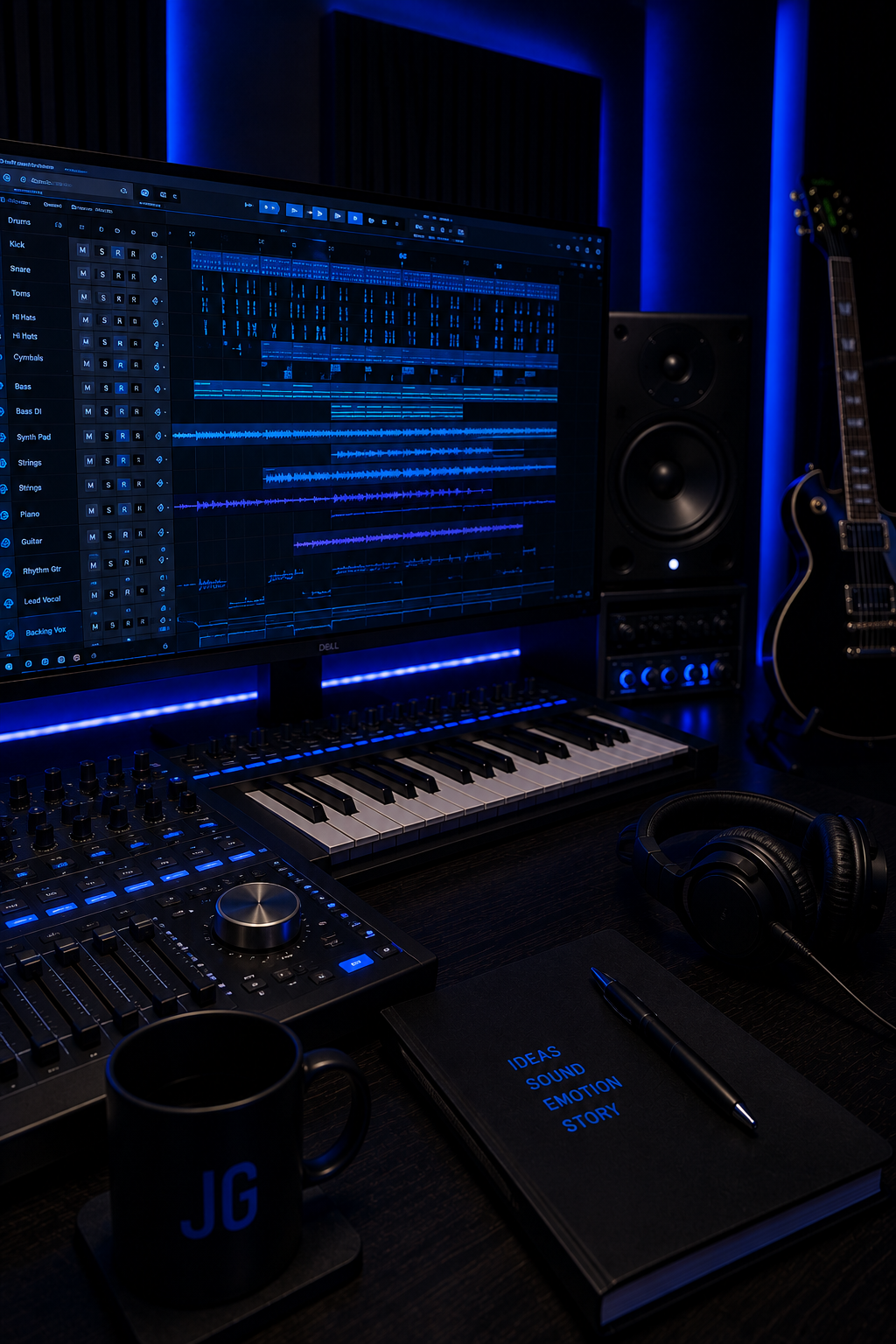
Most of my production workflow is done in Cubase, which allows me to combine MIDI, virtual instruments, audio, automation, effects, mixing, and other production tools within a single workflow. I also use digital processing tools to develop detailed productions across a range of musical styles.
When it's appropriate for a project, emerging technologies can become part of the production process. But I don't believe technology should determine the creative direction. A larger sample library doesn't automatically create better music. More tracks don't always create a bigger production, and adding another effect doesn't always make something sound more polished. Technology gives us options, but creative judgment determines which of them actually serve the music.
Preparing the Final Mix
Once production is complete, the project needs to make the transition from a collection of individual elements into a finished track. Because I also provide mixing and mastering services, the project can stay within the same workflow (even through its final stages).
During the mixing process, I can address balance, dynamics, EQ, spatial placement, effects, automation, and overall sonic clarity. Mastering can then prepare the finished mix for consistent playback and final delivery. Keeping these stages connected can be helpful in maintaining the creative intent that has been established during the production process.
Pricing
Music production projects can vary in scope, so pricing will depend on a number of factors. Some of them include the following:
The length of the music.
The amount of existing material.
The complexity of the arrangement.
Instrumentation.
MIDI programming requirements.
Editing requirements.
The number of tracks and production elements.
Whether composing or arranging is required.
Whether orchestration is required.
Mixing and mastering requirements.
The number of revisions.
Turnaround time.
Straightforward productions can often be priced predictably once the project has been reviewed. Larger, more complex, or heavily customized productions may require a custom quote.
Here is my current pricing structure for these services:
Full music production: starting at $750 per song.
Arrangement and production support: starting at $400 per song.
Multi-song EP or album production: custom package pricing.
All of these prices may include creative direction, arrangement support, performance editing, sound selection, virtual instrumentation, tonal shaping, mixing, and final delivery.
I specialize in remote production. Clients can submit recordings and project files in .WAV or any other approved format. If a project requires additional live performances, remote session musicians, or an outside recording facility, these may be coordinated with the client’s approval and will be quoted separately.
More involved projects that require a substantial amount of composing, arranging, orchestration, or additional production work will be quoted according to scope. You can also visit my main Pricing page for rates on all the services I provide.
Hear the Finished Result
Music production is about taking an idea and figuring out what it can become. Sometimes, it's about expanding a simple musical sketch into a complete arrangement. Sometimes, it's about finding the right combination of sounds. And sometimes, it's about removing elements until the music has the space it needs.
Whatever the starting point, my goal is to create a production that feels intentional, polished, and connected to the original creative idea. If you have music that needs to be developed, produced, or taken to the next level, I'd be happy to talk about your project
Frequently Asked Questions
-
By analyzing its core characteristics (such as tempo, instrumentation, and structure), music can be produced in a variety of styles. The production techniques can also be tailored to match the elements within a specific genre (whether it’s pop, EDM, rock, or metal).
-
Artists can be involved in the production process in any way they feel comfortable with (from complete, hands-on control over every part of the creative process to simply offering final approval). Modern workflows allow artists to take care of the recording, writing, and even mixing. But they may also choose to delegate these tasks to specific people.
-
The ownership of the music is split between the final master (sound recording) and the composition itself (which includes the lyrics and melody). Because they’re the financed production, record labels will usually own the master recordings. But the songwriters and publishers will own the compositions. If you’re an independent artist, you will most likely own both. But it will depend on what’s specified in your contract.
-
Mixing and mastering can be integrated into the production process for a more cohesive and efficient workflow. While they have been separated in the past, taking care of all three stages will allow for real-time adjustments and more immediate feedback on how the final mix fits with the project’s production goals.
I tend to mix as I go along, even during the production stage. This allows me to shape the sound as I form the arrangement. I also tend to mix and master in the same project file, which allows me to make more immediate changes (even if I’m in the mixing stage). My process is all about creating an efficient workflow, which is why it makes sense to do it all in the same session.