
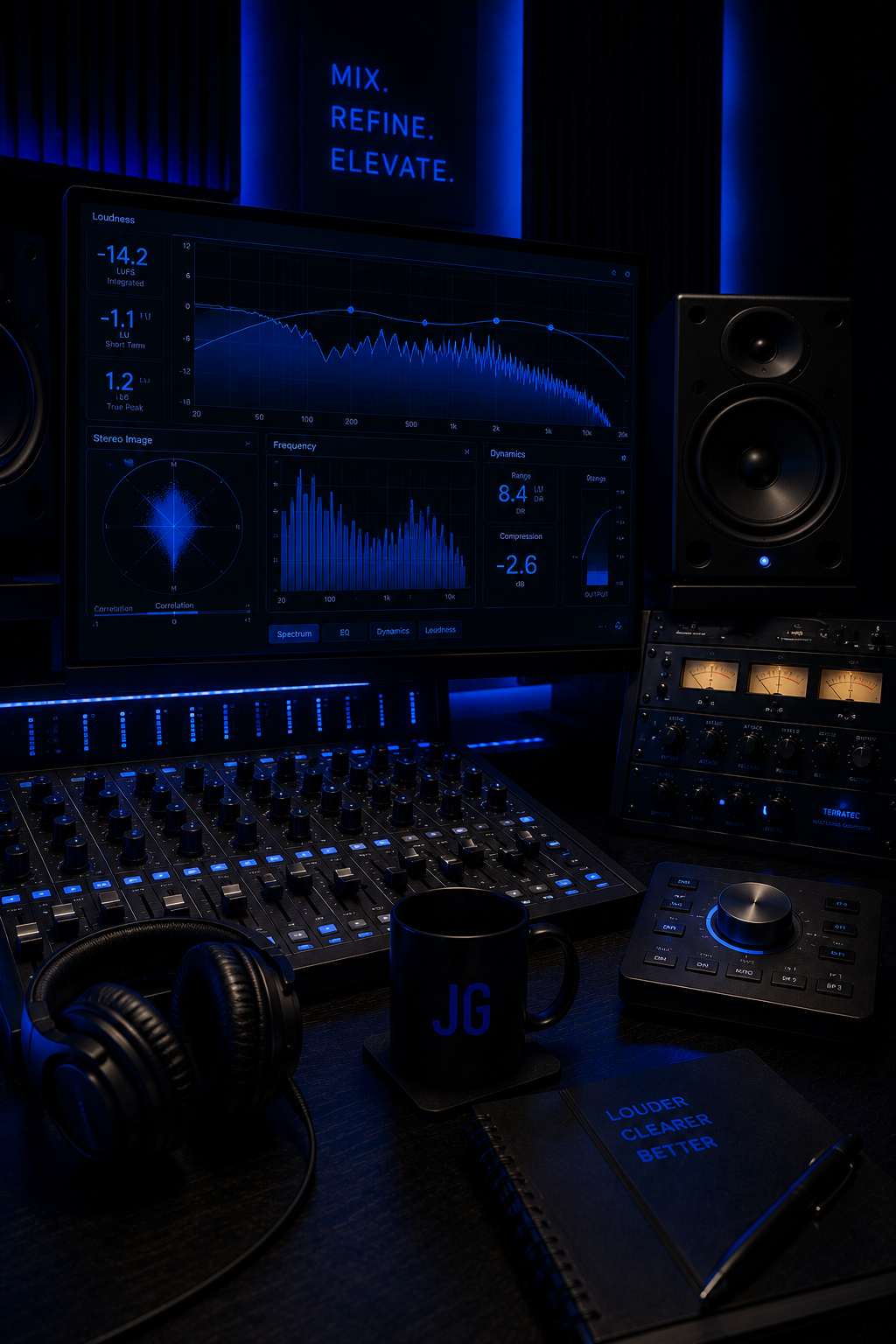
Mixing and Mastering
A finished recording is more than a collection of individual tracks. Every element needs to work together as part of a cohesive whole. The vocals and all the other musical elements have to be clear and present. Instruments need to have their own space. Dynamics need to feel controlled without losing the performance's energy, and the finished mix needs to translate across different listening environments.
I provide remote mixing and mastering services for musicians, composers, producers, filmmakers, content creators, and other creative professionals who want their music to sound polished, balanced, and ready for delivery. Whether you have produced the music yourself, worked with another producer, or used my music production services, I can help you bring the project to its final stages and prepare it for release.
Mixing Is About Perspective
Mixing is often described as balancing tracks, but there’s more to the process than adjusting volume levels. Every part of a production competes for a certain amount of sonic space. A large number of instruments may occupy similar frequency ranges. A vocal or lead instrument may disappear when the arrangement becomes too dense. Low frequencies can become muddy.
Effects can create depth and atmosphere, but they can also make a mix feel distant or unfocused (especially if they have been overused). A good mix addresses these relationships while preserving the musical character of the production. My goal isn't to make every track equally prominent. My goal is to determine what listeners need to hear and when they need to hear it.
Creating Balance and Clarity
One of the most important parts of mixing is establishing a clear relationship between the individual elements of a production. This can involve a combination of the following:
Level balancing.
Equalization.
Compression and dynamics processing.
Stereo placement.
Automation.
Reverb and delay.
Tonal shaping.
Low-frequency management.
Transient control.
Bus and group processing.
Effects processing.
Overall mix balance.
These tools allow me to shape the mix, but they aren't goals in and of themselves. EQ should have a reason for being applied. Compression should support the performance instead of removing its natural dynamics. Reverb should help establish depth and space without diluting any of the important details. The ultimate goal is to use processing deliberately and to create a mix that feels clear, balanced, dimensional, and musical.
Creating Space in the Mix
A common problem in dense productions is that individual elements may sound good on their own but can start to compete with each other when they’re played together. And the solution isn't always to make something louder.
Sometimes an instrument needs less going on in the low-frequency spectrum. Another part may need to move within the stereo image. A small automation adjustment may allow an important musical phrase to stand out more. In some cases, the problem lies in the arrangement itself.
Because I also work as a composer, arranger, orchestrator, and music producer, I can look at these problems from both a musical and technical perspective. Sometimes, the best solution to a mixing problem isn't another processor. Sometimes, it's about understanding what the music is trying to do.
Dynamics and Musical Expression
Dynamics are an important part of music. A mix shouldn't always be at the same intensity from beginning to end. A quiet section needs room to feel intimate so a larger section can feel more impactful when it arrives.
Compression and other dynamic processing can be helpful for controlling individual elements and creating consistency, but excessive processing can remove the contrast and movement that make a performance engaging. My approach is to maintain control without eliminating expression. The final mix should feel polished while still allowing the music to breathe, move, and develop naturally.
Mixing Different Types of Music
Every style of music requires a different approach. A cinematic track being played by a large orchestra may depend on depth, dynamics, and the relationship between instrumental sections. An electronic production may require precise low-frequency control and detailed layering. A track being played by a singer-songwriter on an acoustic guitar may need the vocals and lyrics to be at the center of a mix. A commercial cue may need immediate impact while also leaving room for dialogue or narration.
My mixing work can accommodate a range of musical applications, which can include the following:
Cinematic and orchestral music.
Commercial and advertising music.
Corporate and branded content.
Documentary music.
Music for animation.
Electronic and hybrid productions.
Instrumental music.
Singer-songwriter projects.
Independent releases.
Music for film and visual media.
Instead of applying the same processing chain to every project, I approach each mix according to what the music actually requires.
Mixing Music for Visual Media
Music that’s being used for picture may need different considerations than music that's meant to be a standalone release. A mix may need to coexist with dialogue, narration, ambiance, and other audio elements. Certain frequencies may need to be controlled, so the music doesn't interfere with speech. Dynamics may need to support the visual pacing, and the music may require alternate versions for different stages of production.
My experience in audio post-production and music for visual media allows me to think about these requirements during the mixing process. Depending on the project, I can also provide alternate mixes, stems, or other agreed-upon deliverables for use in the final video or film mix.
Preparing Your Tracks for Mixing
A well-organized session can help the mixing process move more efficiently. And because my services are designed to work remotely, clients can provide individual audio tracks or stems digitally. Before the project begins, I'll establish the preferred file format, sample rate, bit depth, starting point, and other technical requirements.
In most cases, the supplied tracks should:
Start from the same timeline position.
Be clearly labeled.
Be provided at full resolution.
Avoid unnecessary clipping or limiting.
Include important creative effects when they're part of the sound.
Include a rough mix when available.
Include reference tracks when appropriate.
Be accompanied by any relevant production notes.
If you're not sure about how to prepare the files, we can determine the appropriate delivery format before you send the project.
My Mixing Process
While every project is different, my mixing workflow usually involves the following stages:
Reviewing the Material – I listen to the supplied tracks, rough mix, references, and project notes to understand the creative direction and to identify any potential technical issues.
Preparing the Session – I organize the material and establish a clean, efficient mixing environment.
Building the Mix – I develop the overall balance and use EQ, dynamics, stereo placement, effects, automation, and other processing as needed.
Detailed Refinement – Once the overall mix is working, I focus on smaller details (such as transitions, automation moves, frequency conflicts, dynamics, and tonal consistency).
Client Review – You will receive a version for evaluation and can provide feedback in accordance with the agreed-upon revision process.
Final Mix Delivery – After the mix has been approved, I prepare the files and any additional agreed-upon versions or stems.
If mastering is also part of the project, the approved mix can move directly into the mastering stage.
What Mastering Does
Mastering is the final stage between the completed mix and the finished audio file. While mixing focuses on the relationships between individual tracks, mastering focuses on the stereo mix as a whole. The mastering process can address any of the following areas:
Overall tonal balance.
Dynamics.
Loudness.
Stereo image.
Low-frequency control.
Peak management.
Consistency between multiple songs.
Final sequencing for multi-song projects.
Preparation for the intended delivery format.
Mastering isn't meant to rebuild a problematic mix. Its purpose is to make careful adjustments, so an already strong mix translates more consistently and is ready for its intended destination.
Mastering Without Losing the Mix
One of the risks involved in the mastering process is making a track louder at the expense of everything else. Loudness can be important, but it isn't the only part of a successful master. Excessive limiting can reduce transient impact, flatten musical dynamics, and make a track more exhausting to listen to.
At the same time, excessive tonal processing can change the character that was established during production and mixing. My approach is to make the master competitive and appropriate for its intended use while preserving the qualities that make the mix work. Mastering should finish the music – not fight against it.
Mastering Singles, EP’s, and Albums
Mastering becomes more important when several songs need to work together as a group. Individual tracks may have been produced or mixed at different times and with different instrumentation, arrangements, or sonic characteristics. Even if every individual mix sounds good, the project may not feel consistent when the tracks are played in sequence.
For EP and album projects, I can look at the songs as a group.
I can also work toward greater consistency in any of the following areas:
Perceived loudness.
Tonal balance.
Dynamics.
Low-frequency response.
Stereo presentation.
Track-to-track continuity.
The goal isn't to make every song sound identical. The goal is to make them sound like they belong together.
Mixing and Mastering Are Different Stages
While mixing and mastering are closely related, they serve different purposes. Mixing works with the individual elements of a production, while mastering focuses on the completed mix. Keeping that distinction clear is important, because some problems must be solved during the mixing process.
If a vocal is buried, if a snare is too loud, or if instruments are fighting with each other, fixing the individual tracks will usually produce a better result than trying to fix the problem during the mastering stage. If I see a significant issue with a supplied mix before I start mastering, I will let you know instead of trying to force a mastering processor to solve a problem that needs to be addressed at an earlier stage.
A Connected Production Workflow
You can hire me for one service or the other, but both mixing and mastering can become part of a larger project. Because I provide composing, arranging, orchestration, music production, and audio post-production, I can take your project through several stages while maintaining continuity between the creative and technical decisions.
A project can move from composition and arrangement into music production. It can then move into mixing and final mastering – all without requiring the creative direction to be re-established at each stage. If you already have completed productions, I can work with the supplied multitracks or a finished stereo mix.
Pricing
The cost of mixing and mastering will depend on the project's size and complexity, the condition of the supplied material, the number of tracks, the required deliverables, and the amount of work that’s needed to achieve the desired result.
My pricing for mixing includes the following:
Stereo mixing: starting at $350 per song.
Stem mixing: starting at $400 per song.
Complex or high-track-count sessions: custom quote.
Five-song EP mixing: package pricing available.
Full-album mixing: custom package pricing.
All of these prices include two rounds of revisions and delivery of the final high-resolution stereo mix (unless otherwise stated). Instrumental versions, alternate edits, stems, and additional deliverables may incur an additional fee. The prices also assume you have properly prepared and organized tracks. Projects that require extensive editing, timing correction, tuning, restoration, or other production work may require an additional quote.
For mastering projects, I will need to review the supplied mix before I start working. If I believe an issue would be better corrected in the mix, I will let you know before I move forward with the project.
Here is my pricing structure for all of my mastering services:
Single-track mastering: starting at $100 per song.
Five-song EP mastering: starting at $450.
Ten-song album mastering: starting at $800.
Alternate, instrumental, or performance versions: additional fee.
These prices include a high-resolution master and a version that’s prepared for digital distribution. Additional formats can be provided upon request. Discounted package pricing may also be available for multi-song projects.
Combining mixing and mastering can create a cohesive workflow from the initial mix through final delivery. That's why I offer the following packages:
Single-song mixing and mastering: starting at $425.
Five-song EP mixing and mastering: starting at $1,900.
Ten-song album mixing and mastering: starting at $3,600.
Package pricing assumes that all files are properly labeled, organized, and ready to mix. Extensive editing, tuning, restoration, or session preparation may require an additional fee.
Feel free to visit my main Pricing page for rates covering all of the services I provide.
The Final Stage Shouldn't Feel Like an Afterthought
A great composition and a strong production deserve to be heard at their best. Mixing creates the relationships between all the individual elements. Mastering provides the final perspective and prepares the completed music for delivery.
Both stages require technical tools, but the decisions behind them remain musical. My goal is to preserve what makes the project unique while giving it the clarity, balance, impact, and polish it needs to feel complete. If you have a track, score, single, EP, album, or any other project that's ready for mixing or mastering, I'd be happy to talk about what you're working on.
Frequently Asked Questions
-
The mixing process involves taking raw tracks and blending them into a cohesive song that’s well-balanced. This can be achieved through the use of various techniques (such as panning, EQ, and compression). The term “mastering” refers to the final step before a track is released. The completed stereo mix is processed for optimal loudness and consistency (while making sure that it translates across all playback systems).
-
Mastering is the final polish, but it won’t fix a poor mix. That’s why every track will need to be mixed, balanced, and finalized before it can be sent in for mastering.
-
Mixing and mastering engineers can work across a variety of genres and project sizes, but the most successful will either specialize or develop a great deal of versatility to handle more diverse projects. While the core principles of working with audio are universal, the techniques, aesthetic goals, and technical requirements can vary between styles.
-
Music that has been recorded in a home studio can be mixed and mastered, but getting good results in the final mix will depend on the use of proper gain staging and accurate monitoring to compensate for room acoustics. It will also depend on the effective use of EQ, compression, and limiting techniques.