
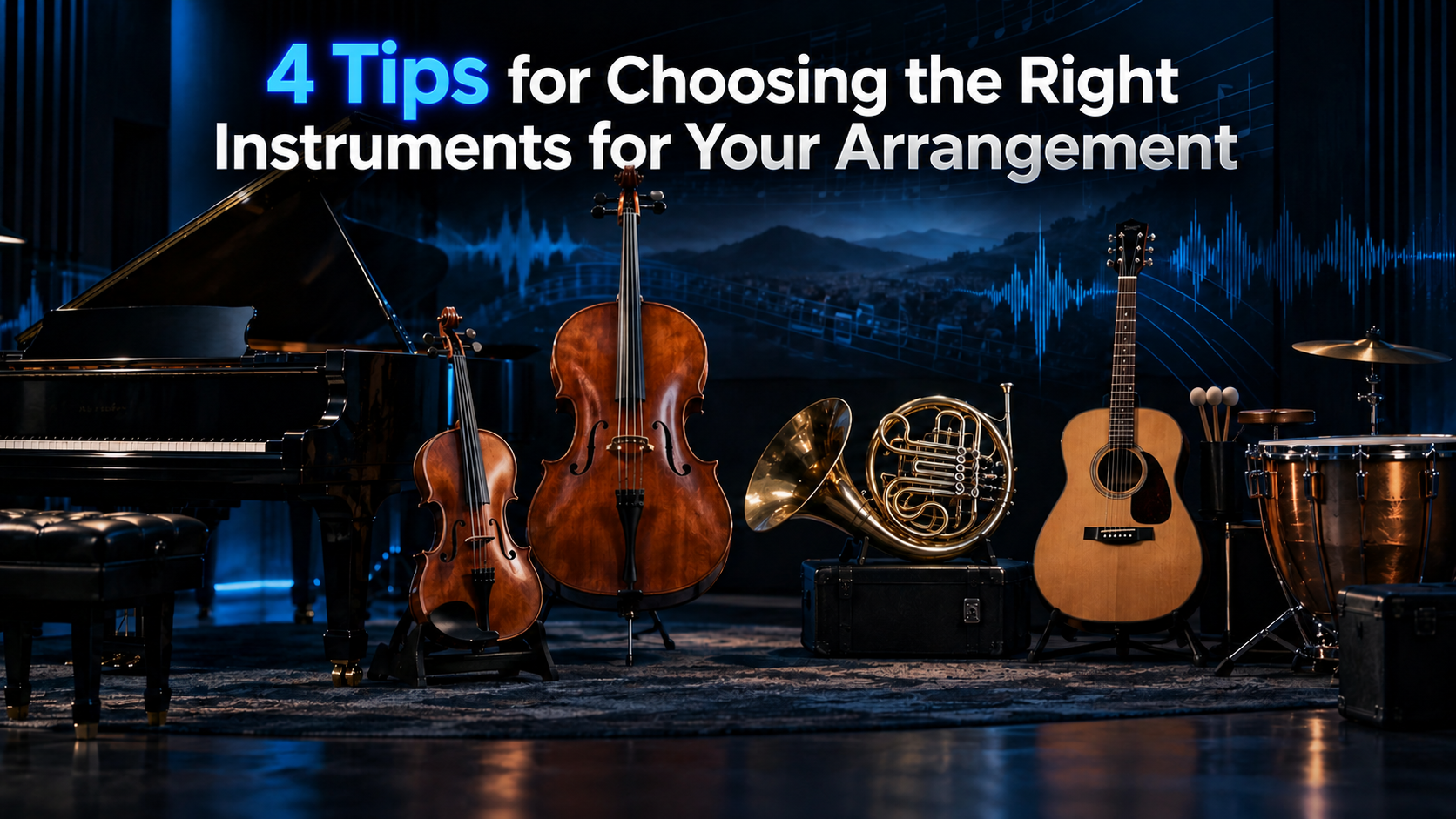
One of the most important decisions you’ll make when you’re writing a new piece is with regard to the instrumentation, because the same melody being played on a piano will feel different than if it’s performed by a string quartet. Choosing the right instrumentation can turn a melody into a fully realized piece of music.
Here are some tips that can help you choose the right instruments for your arrangement.
1. Start with the Soul of the Piece
Before you decide on instrumentation, think about the piece’s emotional core. What kind of story is it trying to tell? What kind of personality does it have? Is it joyful and bouncy, or is it heartbroken and aching? Different instruments will convey different emotions. Here are some common examples:
Epic, heroic, or militaristic — Brass (including trumpets and horns), timpani, snare drums, and low strings.
Intimate and vulnerable — Solo piano, acoustic guitar, solo cello, and a voice with minimal accompaniment.
Playful and light — Flute, marimba, pizzicato strings, glockenspiel, and clarinet. The bassoon also has a kind of playfulness that works well with these types of pieces.
Melancholic and nostalgic — Cello, oboe, French horn, and accordion.
Aggressive and modern — Electric guitar, distorted bass, programmed drums, and synths.
Sacred and transcendent — Choir, organ, harp, and sustained strings.
You don’t have to pick only from this column. Most great arrangements will mix different categories in various places. A heartbroken ballad with a single trumpet line over a piano can be more devastating than if you used either one by itself.
2. Think About the Piece’s Landscape and Setting
A good piece of music with the right instrumentation can transport listeners to a specific place. Here are some specific examples where instrumentation can evoke images of a specific place:
Desert and warmth — Oud, ney flute, and hand drums.
Forest and nature — Flute, harp, soft strings, and bird-like high woodwinds.
City and urban energy — Saxophones, brass, electric bass, and a drum kit.
Ocean and wide spaces — Harp, fluid string lines, and French horns.
Instrumentation can also evoke images of specific regions. The accordion is often associated with France and Argentina. Bagpipes can conjure up images of Scotland. The shamisen is often associated with Japan, while the bandoneón is often associated with Buenos Aires. And of course, the banjo gives reference to the American South.
3. Match Instruments to the Range of Your Melody
Every instrument has its own comfortable range (what orchestrators call the “tessitura”), so your melody will work well on some instruments but not so well on others. Forcing an instrument to play a melody that moves too far beyond its comfortable range can make it sound strained.
Here are some of the basic instrument ranges along with some common examples:
Soprano (high) — Flute, piccolo, violin, trumpet, and soprano sax.
Alto (mid-high) — Oboe, clarinet, French horn, viola, and alto sax.
Tenor (mid) — Trombone, English horn, classical guitar, and tenor sax.
Baritone (mid-low) — Cello, baritone sax, bassoon, and euphonium.
Bass (low) — Contrabassoon, tuba, bass clarinet, and bass guitar.
If your melody sits between middle C and the C an octave above, you have a broad choice of instruments (such as the violin, flute, clarinet, alto sax, guitar, and the piano’s right hand). If it sits two octaves above middle C, your options narrow down to the piccolo, high violin, or high flute. Make your choices based on the timbre you want, but make sure the ranges work for each instrument.
4. Use Genre Conventions as a Starting Point
Every genre has a specific set of instruments that listeners expect to hear. You can either work within those expectations, or you can deliberately break them. Here are some examples of various musical genres and the types of instrumentation that are associated with them:
Folk — Acoustic guitar, mandolin, fiddle, banjo, double bass, and harmonica.
Rock — Electric guitar, bass guitar, drum kit, and vocals. You can sometimes hear keyboards, synths, and brass.
Jazz Combo — Piano, double bass, drums, and one or two horns (including sax, trumpet, and trombone).
Big Band — Five saxes, four trumpets, four trombones, piano, bass, drums, and sometimes guitar.
Classical Orchestra — Strings (violins, violas, celli, and basses), woodwinds (flutes, oboes, clarinets, and bassoons), brass (horns, trumpets, trombones, and tuba), and percussion.
String Quartet — Two violins, viola, and cello.
Pop — Vocals, drums, guitar or keyboard, and sometimes strings or synth pads.
Electronica — Synths, drum machines, samplers, and processed vocals.
You can start with a basic genre convention and make one or two surprising choices. Adding a string quartet to a rock arrangement can change the emotional context of the piece. Adding a distorted electric guitar to a string ensemble can do the same thing as well.
Final Thoughts
The fastest way to develop your instinct for instrumentation is to keep experimenting. Write the same piece three different ways, and listen to what each version does to its emotional context. After a while, you’ll start to hear different instrumental choices in every song you listen to.
